
Lida Lewis
PASSIONATE DESIGNER
STORYTELLER
BUSINESS DEVELOPMENT PARTNER
WORKPLACE + HUMAN EXPERIENCE STRATEGIST
WELLBEING DESIGN ADVOCATE
Workplace NEXT


The use of space and the look and feel of office environments have consistently evolved over time; however, the one constant is that companies are always responding to disruptors which lead to change in the workplace. One of the biggest disruptors of our age was the COVID pandemic. Once highly resistant to the idea, companies everywhere had to embrace "working anywhere" as a business strategy--or close shop. In the midst of this disruption, I started to imagine what these new, more flexible work policies might mean for the typical office and lease.
At the time, working remotely was a necessity. But much speculation seemed to be happening around the future of occupancy and what the office might look like--but without much substance. I decided, using a recent Page tower project in Austin, to develop 4 different scenarios of a return-to-office with 4 different premises, and see by putting pen to paper what, exactly, varying levels of future commitments to remote work might mean for the typical modern office.

I began, as we often do, with a program. This one needed some tweaks to fit the already-newly-imagined normal, though.
At the top of the program, I added a typical staff count and growth assumptions by department, to get my future staff count. Then, I added a column to factor in the % of staff in a department who might be on site at any time.
It's always been true that some percentage of the workforce is off site periodically--for meetings, travel, and the like. However, for "purity" in the experiment and to reduce confusion in the end product, I wanted to start by thinking of all individuals being on site at all times.
I am also a big believer in programming for functional needs--a department, a position, rather than the individuals in that person--to best fit the needs of the business. This means that I do vary the types of workstations and what amenities are necessary by department quite routinely. Here again, though, no need to get too fancy, so I simply randomly assigned a number of various personnel (read: individual workspace) types for each department for this fictional company.
From there, I started to play with numbers and vary the space allocations needed in the program , increasing the amount of remote work expected--the number of staff expected to be off site at any given time---with each scenario below.

Scenario A – Typical client, they want to plan pretty much as we would have pre pandemic. All back on the office, planning for 6% growth and 100% of staff on site. Decent amount of conferencing, nothing extravagant. Phone booths and a few lounge chairs around the perimeter help with a few heads down or respite spaces. All personnel spaces are fixed/assigned.


Scenario B – There is still the same 6% growth and 100% of staff on site. But, they’re figuring meetings and conferencing may increase, as well as perhaps having a few more guests hang out for a day or couple days when in town. So they’ve decreased the size of some workstations to make room for a few more guest spaces and conferencing or lounge areas.
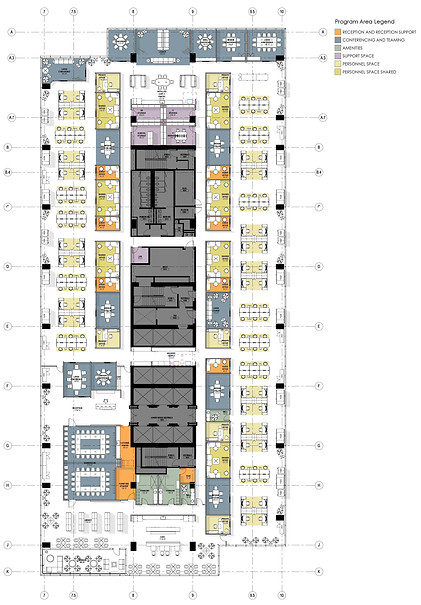

Scenario C – Same growth assumptions, but by department, they’ve started to realize some have more remote work potential. IT, for example, is ok trading off so half are off site and half are on at any given time, and even the execs have decided to lead by example and share space and/or have some of them work remote. There’s now more smaller offices, and because only 75% of people will be on site at any given time and they’ll be providing the option to work off site a couple days a week, the office now needs to really be a place people WANT to go. So now there are more café areas, their own on-floor minor wellness/gym area, changing rooms, and other cool stuff.


Scenario D – Again, same growth. But now they’re throwing caution to the wind and NO department spends all it’s time on site. In fact, only 40% of the workforce is on site on any given day and time. So they’ve now carved out the lower right corner of the plan, about 10K RSF, to either (all are equally viable options).

-
Provide “executive suites” or coworking style short term rentals for the grey area shown in the lower right, with as many or as few of the offices and workstations as they like. For shared amenities, coworking contracts include a shared prorate cost for all amenities in the lower left corner.
-
Have a “friendly sublet” resident that shares use of the wellness/workout room and a sent of changing rooms directly north of that area, as well as the full suite of amenities and conferencing in the lower left corner—sharing the cost of that RSF, and the staff and services used to provide the areas and equipment there with a dedicated concierge.
-
Have a partitioned sublet area by adding a few more doors to separate the space they will keep.

The genius (and yes, I said genius) of this is that:
-
It is equally palatable to the building and the tenant,
-
there is very little restriction on how much or how little you can sublet or rent out to shrink your floorplate,
-
and even the cost of the amenity area in the lower left corner can be mitigated through various scenarios.
-
In fact, if this client decided to do even LESS than 40% on site at any time, the building could take over the space as is as a coworking site, and do the same partitioning for any coworking tenant who grew large enough to want to partition off their own area.
-
If the blocks of solid walled rooms to the right and left of the core were even partially built with demountable partitions, the flexibility of the modules means a very sustainable and fiscally attractive workplace product.
I found this to be a fascinating exercise in demonstrating the effects of remote work on physical space. Assuming my assumptions were all reasonable in the number and proportion of social, collaborative, and mini-amenity spaces needed for the various scenarios, it will take a truly radical change toward remote work for many tenants to generate a meaningful give-back on an office floorplate. Truly, it surprised even me the amount of reductions needed to make a substantive difference in a leasing give-back scenario.
Only time will tell where we're headed--industry by industry, city by city, position by position. But physical space serves a function to advertise a business' stability, identity, and presence--can you imagine having to meet in a hotel or conference space with a company in whose stability and staying power your own business relies? Additionally, given that humans are social animals--ones that build trust by being (critically, it seems, physically) together, it seems unlikely the office will cease to be. Much altered, much more fluid, and with quite a different vibe. But nonetheless, abiding.